Today we are launching Catapult - an evergreen accelerator for scaling new sources of RWA yield onchain. RockawayX is writing first checks into the next generation of founders tokenizing uncorrelated, high-yielding (RWA) assets, then backing them with anchor TVL, liquidity, DeFi integrations, and a mentorship team of the operators who built and scaled RWA businesses.
Catapult combines RockawayX's core verticals - Venture, Liquidity, Market Making, and Vault Curation - so that investment, onchain capital and DeFi integrations come built into the program rather than left to founders to assemble deal by deal. Mentors include founders and executives behind Kamino, Pendle, OnRe, Ethena, Monad, Figure, Exponent, Pareto, Centrifuge, the Solana Foundation, and other leading projects, offering partnership introductions, office hours, and ongoing strategic support sessions.
Why now? Over the last years, RockawayX has built a one-stop platform and balance sheet for solving the RWA cold-start problem and scaling tokenized assets across onchain markets. We incubate and seed projects with venture funding, provide liquidity out of a dedicated $150m+ DeFi vehicle, launch vault products and DeFi integrations that allow global users to easily access them, and provide a market making service to support efficient price discovery and reliable exits as TVL scales.
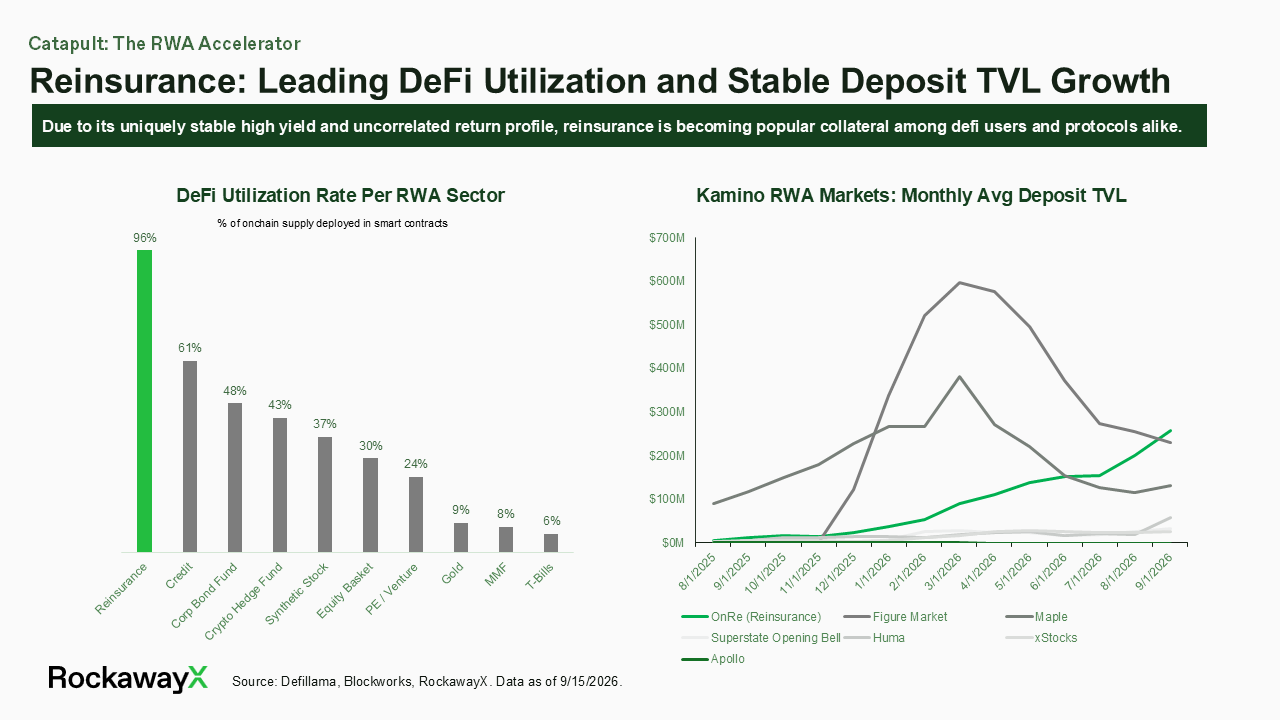
The model is proven. OnRe, a tokenized reinsurance company and RockawayX incubation partner, scaled past $300m TVL in just one year.
Capital is easy to find. A partner who can solve your cold start problem is not. Please see our Request for Startups & RWA Thesis below. Come build with us.
The RWA Opportunity & Onchain Yield
Tokenized RWA markets will explode over the coming years, estimated to reach $2T-$30T in total onchain AUM by 2030, a minimum >50x change from current levels.
Credit markets are a stand-out beneficiary. Citi expects $100B in tokenized private credit by 2030. BCG forecasts 20-30% of all securitized debt to move onchain by 2035, with blockchain rails making the credit lines cheaper and more transparent to originate and trade. If this forecast is realized, it would imply $2.5-$3.8T in structured product AUM onchain - a 1000x increase from today.
We agree that the growth of yield bearing RWAs onchain will be explosive, but onchain yield markets face an obvious gap today - they crave differentiated, scalable yield.
Low yield, high scale assets are abundant, but differentiated yields - defined by high nominal yield and low volatility - are in short supply. As we see in the chart below, most assets cluster near 3-6%, not at all differentiated from the risk free rate of 3.62% or the 10-year yield at 5% as of this writing.
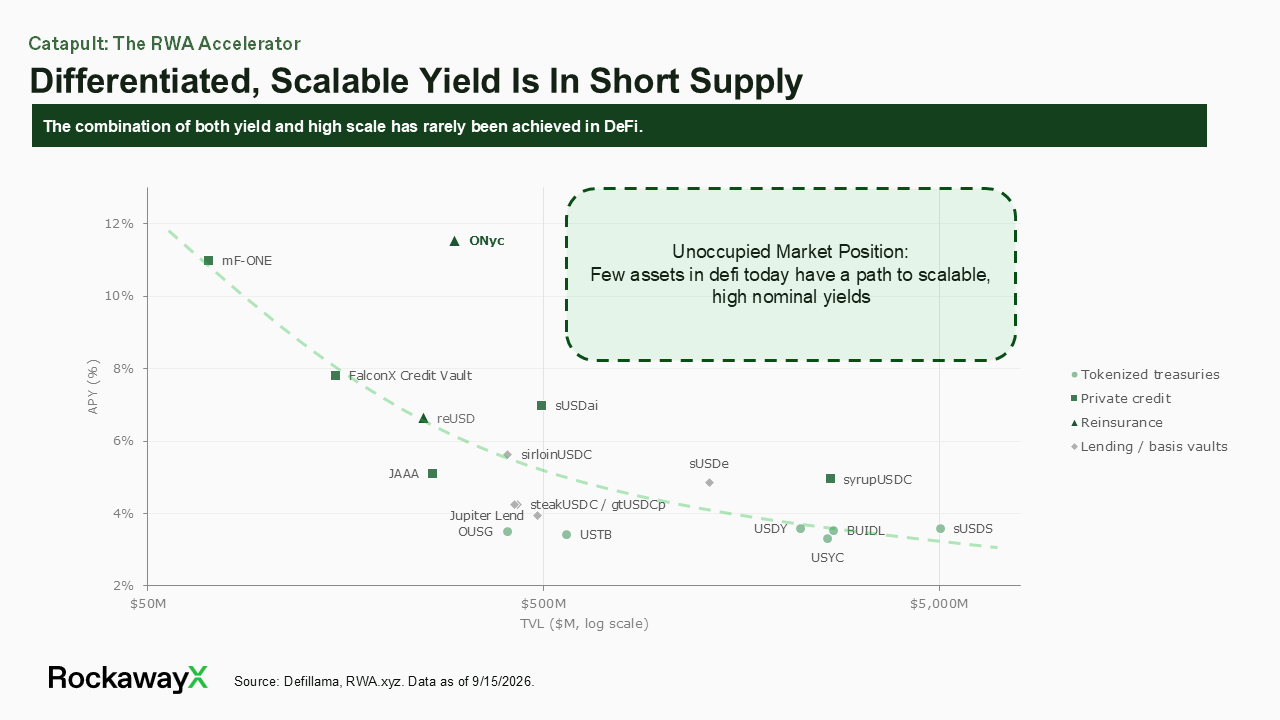
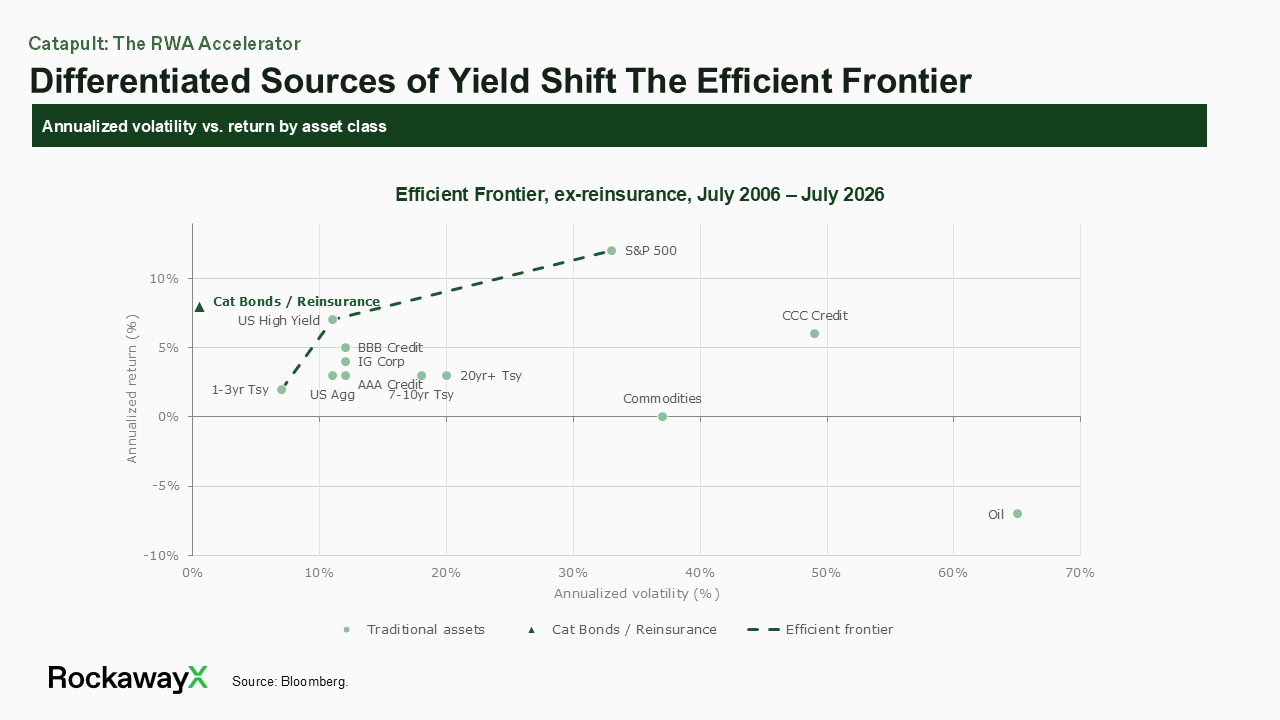
We believe there is ample opportunity for differentiated yield profiles that move the efficient frontier, i.e. adding incremental yield while simultaneously lowering volatility of existing DeFi portfolios.
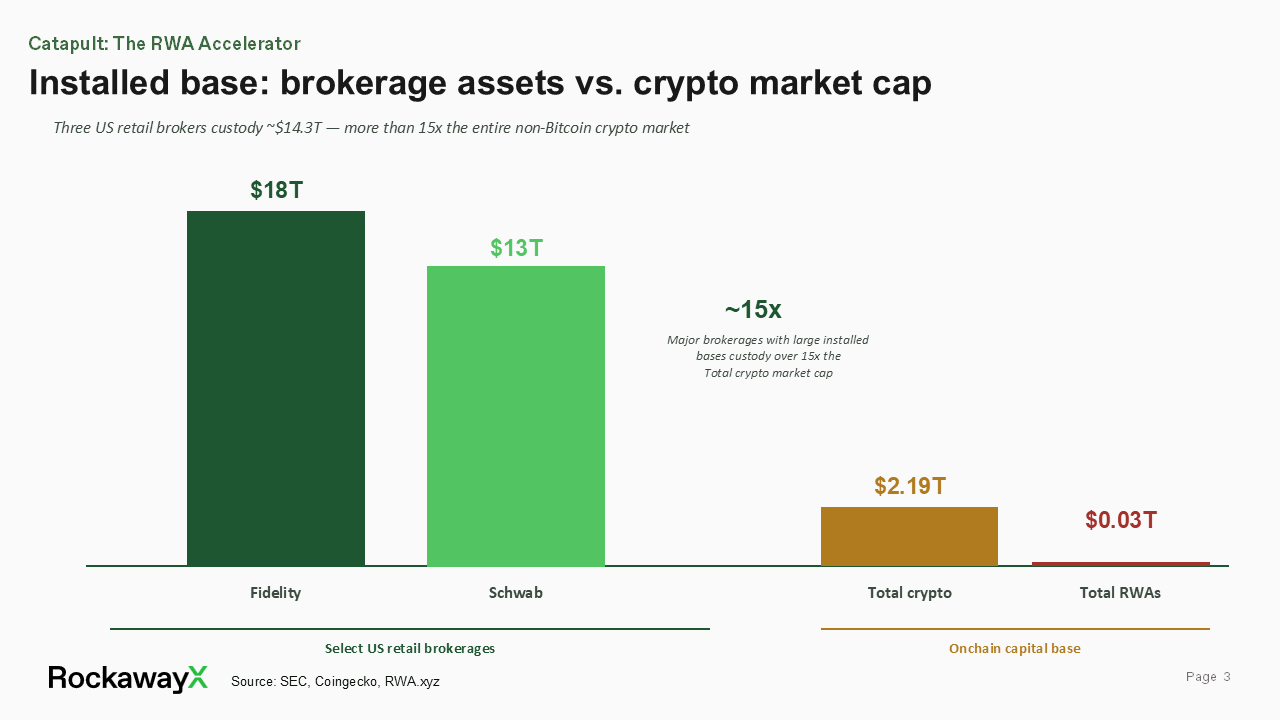
Don’t Compete Against TradFi Distribution
Most assets being tokenized onchain today already live on platforms with large installed bases, deep customer lock-in, decades of built-in customer familiarity and loyalty, and finance and tax reporting workflows. Said another way, why buy an asset onchain when it is already one click away in a traditional brokerage? By any measure, many RWA founders are competing uphill against deeply entrenched incumbents.
We believe founders should focus on assets not widely available through traditional channels that confer direct, immediate quantitative benefit to existing high-risk onchain portfolios. Onchain portfolios are saturated with correlated risk. So the immediate, measurable benefit of diversification - high sharpe, low correlation assets which raise a portfolio’s expected return while reducing volatility - is a differentiated value proposition with a clear wedge.
We’re seeing this play out in DeFi today: reinsurance, a high-Sharpe, uncorrelated asset class that is not widely accessible on mainstream brokerage platforms, is demonstrating significant demand among both users and protocols.
Reinsurance is insurance for insurance companies, including protection against catastrophe risks such as hurricanes and earthquakes. The asset class has structurally low correlation to risk markets because geographically idiosyncratic weather events occur independently of equity or crypto markets. Importantly, reinsurance pairs high yield with remarkably low volatility. Since 2006, the asset class has returned 8% annualized with just 0.5% volatility and a 0.05 correlation to the S&P 500 (essentially zero). In the higher rate environment of the past three years, the profile has been even more exceptional - the Swiss Re Cat Bond Index has delivered a 13% CAGR with 2.8% volatility and a -0.07 equity correlation, an est. Sharpe Ratio of 3.1, versus just 1.1 for the S&P 500.
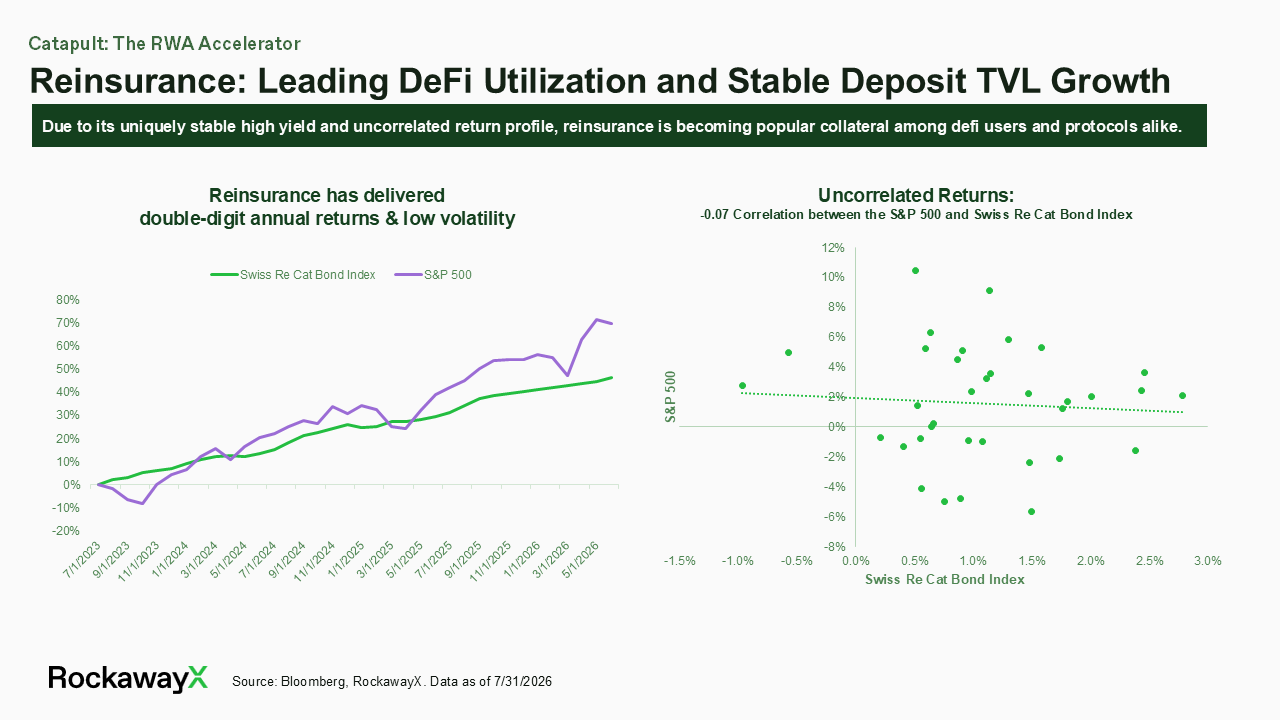
This profile makes reinsurance exceptionally attractive collateral in DeFi. Low volatility allows loopers to lever their position for additional yield with minimal risk of negative basis. As a result, reinsurance RWAs command the highest utilization rates in crypto (the share of outstanding assets deployed in smart contracts rather than supply held idle in wallets). Projects benefit from reinsurance collateral as well - the asset class adds ballast to the protocol’s deposit base. While onchain lending markets have suffered bear market outflows, isolated reinsurance markets on lending protocols have kept growing.
All RWAs Are Not Equal: A Suitability Framework For Judging Asset Fit
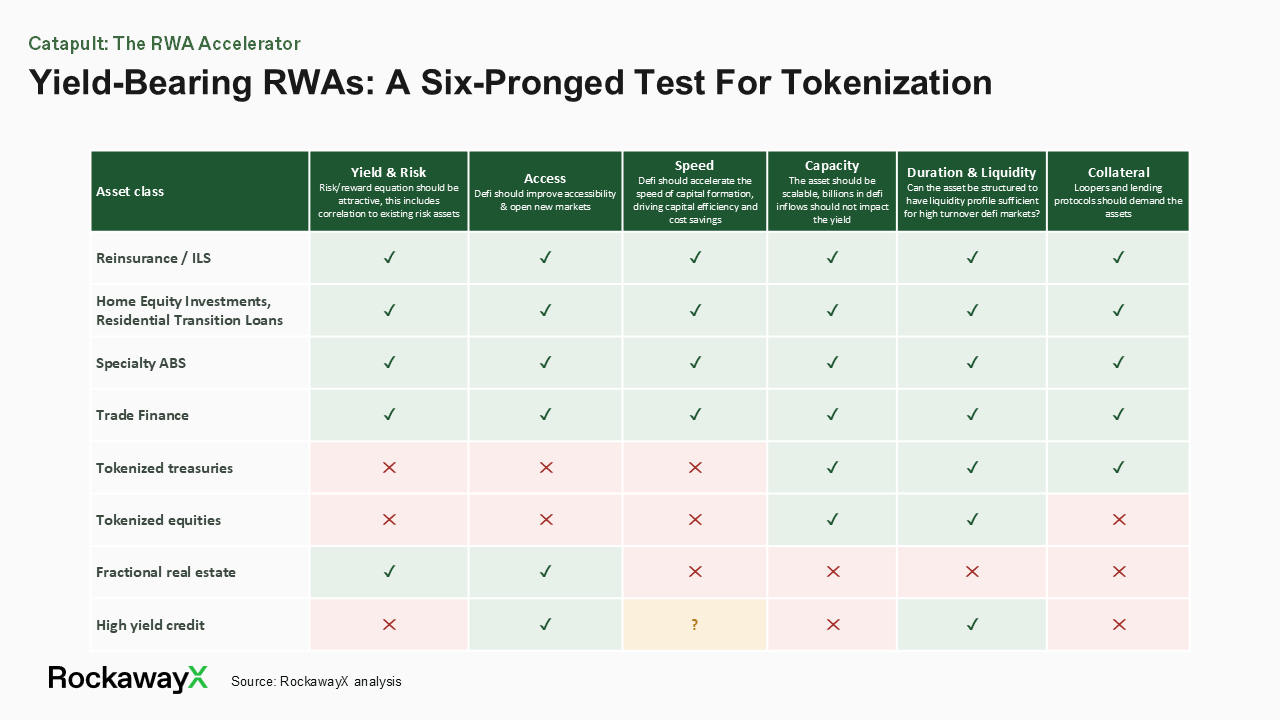
We believe reinsurance is just one of the many yield sectors with unique risk/reward profiles that offer founders a unique wedge to accelerated scale onchain. Below we review six characteristics for identifying the next generation of high adoption yield-bearing RWAs.
Yield & Risk. Founders must be mindful of the asset's risk/reward equation. Yields of 7-12% are empirically attractive to DeFi users, whereas 15%+ yields come paired with a risk profile too similar to equities and crypto tokens. This is not true of all high yielding instruments however. Trade Finance yields routinely stretch beyond 15%, and the paper is so high turnover that the risk is much lower than similarly yielding instruments, e.g. CCC bonds. The yield / risk equation should be sufficiently attractive to DeFi investors, but if risk is too high, onchain users would be better off simply holding tokens or stocks.
Access. The asset should not already be widely available on traditional brokerage platforms - tokenizing assets that are too commonly available means you are competing with distribution of TradFi giants and traditional brokerages, and these channels are dominated by familiar TradFi brands. Take low yield, low risk assets like t-bills. Yes, t-bills have scaled to billions onchain, but the risk profile of these assets is undifferentiated and widely accessible, so the economics of these businesses have compressed to custody-like returns. These assets proved that yield-bearing RWA issuance onchain has PMF, but the economics are thin necessitating ultra high scale, and the field is now brutally crowded. Crypto rails should enable founders to turn a red ocean market into a blue ocean, creating a sufficient wedge to attract net new AUM.
Speed. RWA issuance should accelerate the speed of capital formation, fundamentally changing some dimension of the RWA and/or its supply chain. In structured credit, we’re seeing this early innings of a transformation first hand, where originators are tapping DeFi markets as a warehouse facility to accelerate the pace of securitizations, therefore limiting risks and cutting costs in the securitization supply chain. Companies like Figure are cutting over 80bps of cost out of HELOC securitization leveraging onchain warehouse facilities. We think this is repeatable across many securitization markets.
Capacity. The RWA should be sufficiently scalable. Yield markets are naturally capacity constrained, but some are so more than others. Supply chain finance, consumer ABS and reinsurance can take on billions in DeFi capital without impacting yields. In contrast, more niche sectors of the market, like certain capacity constrained hedge fund spread trades or tokenized crypto basis trades, can quickly see yields compress under moderate inflows.
Duration & Liquidity. Crypto is a trader's market defined by high capital turnover. Slippage and secondary market/redemption liquidity are therefore of primary importance. The product must scale to a sufficient liquidity profile, and project economics must be structured such that market makers can safely provide liquidity during stress and facilitate regular redemptions with low slippage. The RWA must be structured in a way that mitigates high slippage which eats at the yield profile of the asset.
Collateral. Crypto’s most successful primitive is leverage. Low volatility, secondary liquidity, and sustainable high yield are the primary characteristics of attractive DeFi collateral. For an asset to be successful in DeFi, lenders should want to list it and borrowers should feel relatively safe looping it.
Here we introduce our Yield-Bearing RWA test, and highlight what we believe are some of the highest potential areas for tokenization.
The RWA Supply Chain
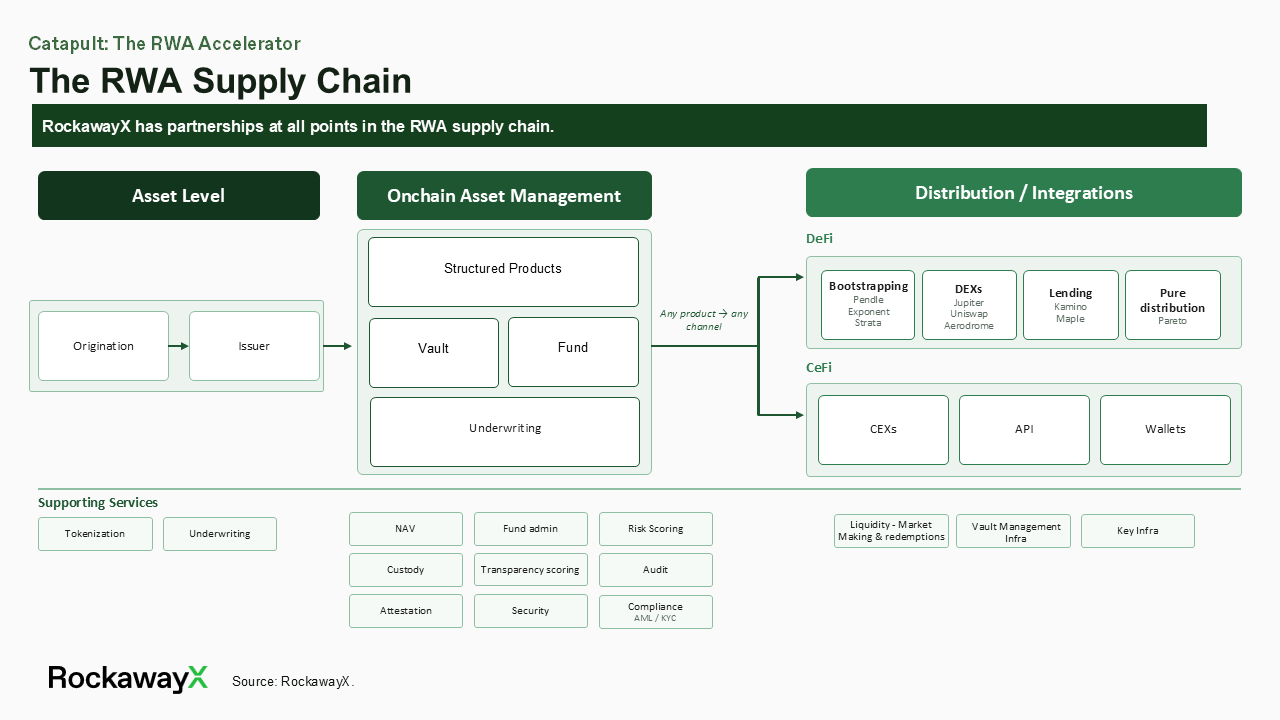
The diagram below represents the RWA supply chain as we see it. At the asset level, originators and issuers source, underwrite, and structure the underlying exposure. Onchain asset managers take that exposure, package it, and manage the risk, as a vault, a fund, or a structured product, with underwriting and risk management built into the fund wrapper. The distribution layer is where the end investor acquires the exposure. Underneath each layer sits supporting services that every company in the supply chain depends on.
RockawayX has operated across this supply chain for years. At every point in the chain, there are businesses and founders we have partnered with and built alongside of, since well before "real world assets" was even a category. We’ve seen first hand how originators bring new asset classes onchain, asset managers and vaults to build AUM, and how lending markets, exchanges, and wallets acquire and distribute RWAs to end users.
Catapult & The RockawayX RWA Stack
As a response to the opportunity ahead, we’re launching Catapult, a selective, evergreen accelerator program purpose-built for yield-bearing RWAs.
Rather than the standard cohort-and-demo-day model, Catapult combines RockawayX's core verticals - Venture, Liquidity, Market Making, and Vault Curation - so that investment, liquidity, and DeFi integrations are built into the program itself rather than left to founders to assemble deal by deal. Participants also get direct access to a mentor bench of operators who have already scaled the RWA businesses onchain, including the founders and executives behind Kamino, Pendle, OnRe, Ethena, Monad, Figure, Exponent, Pareto, Centrifuge and the Solana Foundation, through intros, office hours, and ongoing founder sessions.
The core of the program is the capital & infrastructure behind it: the RockawayX RWA Stack. The RockawayX RWA Stack is our repeatable playbook and end-to-end capital & product partnership designed to help founders solve the cold start problem and rapidly scale RWA TVL from zero to nine-figures and beyond.
The RockawayX RWA stack is built on our firm’s first-hand experience building and scaling onchain products. We’ve worked deeply with RWA founders across their product lifecycles: First, we helped position Idle Finance from a pure tranching model into a full stack origination platform, relaunching as Pareto Credit, now home to some of the most popular credit strategies in DeFi. Then we worked hand-in-hand with OnRe, from product structuring to LPing and vaults infra. OnRe now stands as the fastest-growing yield-bearing RWA protocol on Solana with over $300M in active TVL and multiple product lines.
From these and other experiences, we’ve developed a framework to address the pain points of scaling RWAs, delivered through three balance sheets deployed in sequence and working with the issuer across the RWA product lifecycle.
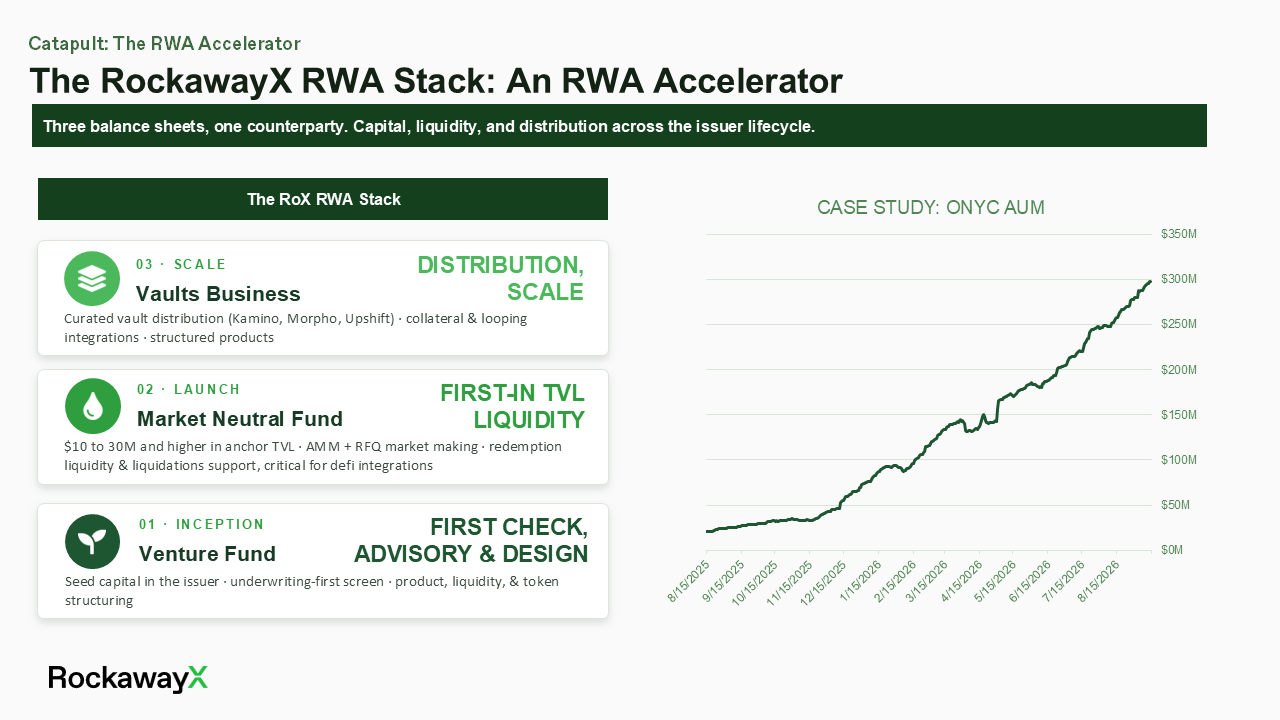
At inception, we are the first check in and product partner. Our Venture Team invests at the ground floor and offers full-stack advisory on product, GTM, and tokenomics. Most projects underestimate what DeFi actually demands of a product: the structures, mechanics, and token design that determine whether an asset can ever loop, list, or scale. We work hands on with founders, informed by having run this playbook repeatedly end-to-end.
At launch, we are the first to add TVL & provide liquidity. Our Market Neutral Team deploys anchor TVL that solves the cold start problem, and provides redemption liquidity, signaling quality LPs to follow on. Beyond the initial TVL deposit, we operate secondary market liquidity infrastructure: actively managed AMM pools and a dedicated RFQ desk seeded with our own capital that stands as counterparty for sizeable redemptions and serves as last-resort liquidator. This liquidator function is a necessity for DeFi integrations - no lending protocol will list an RWA without sufficient liquidity to facilitate liquidations and minimize the risk of bad debt.
Then, we become the distribution layer that enables rapid scale. Our Vaults Team and integrations across Kamino, Morpho, Pendle, Loopscale, Exponent, Juplend, and Euler position your RWA as working collateral across DeFi at scale. This positions your asset as a prime asset for looping which accelerates TVL.
OnRe & The RoX RWA Stack: A Case Study In Scaling RWAs Onchain
When we met the OnRe team led by Dan in early 2025, we immediately knew they were exceptional. Since then, Dan and Ayyan have built out an institutional-caliber reinsurance underwriting and risk management operation, alongside an experienced underwriting team, leveraging crypto rails and rapidly scaling OnRe to over $300M in TVL, with growth now at an inflection point. But on day one, it was not clear to the DeFi markets that reinsurance was worth integrating or allocating to.
Reinsurance is a difficult product to place, even with professional investors. The risk premium is unfamiliar, the industry is opaque, and the contracts ultimately necessitate highly specialized underwriting. This complexity led to a classic cold start problem. Protocols won’t list an asset without a liquidator, LPs won’t deposit without listings.
Startups are plagued by path dependency, and cold start problems are a tremendous challenge for even the most seasoned founders. We leveraged all the resources of the RockawayX platform to help solve this start problem and accelerate a path to rapid TVL growth.
We invested in OnRe in March 2025. Step one was to work with the team as design partners to reshape their offering from an investment pool for reinsurance assets to a yield-bearing token that generates returns from the underlying. The structure could be integrated across DeFi much more seamlessly. Next, we helped structure the product, designating the appropriate liquidity terms, depth, redemption readiness, and looping profile for onchain institutions and retail investors alike. We seeded $4M in liquidity in an AMM pool with a market making bot to ensure price stability on ONyc on the secondary market, and an initial $10M in LP liquidity to show our conviction. We provided an additional $2M to bootstrap liquidity of ONyc on Kamino. The RoX Market Neutral Team helped structure an incentive program for new LPs to attract follow-on capital. Since the team has been in crypto and worked for countless LPs over many years, they have seen all varieties deals and knew the precise structures and terms counterparties are looking for. The key unlock for scaling any RWA is integrations, especially for esoteric exposures like ONyc. Once DeFi protocols knew a trusted and frequent partner was providing liquidations, intros and integration talks went smoothly.
Our vaults business provides diversified access to the ONyc token, with ONyc the top holding in our USDC vault on Kamino.
Request For Startups
We’re excited to build alongside founders bringing genuinely differentiated yield onchain in the asset classes highlighted in this thesis - trade & supply chain finance, specialty ABS, CLOs, real-estate derived credit instruments like HEIs and RTLs. If you are building in these and adjacent asset classes, we believe crypto rails and the RockawayX liquidity program are the best GTM wedge for your project.
What you get from us is everything this report describes - deep product partnership, anchor TVL, market making and liquidity at launch, DeFi integrations and vault distribution.
If you’re building in these markets - or in one we missed that passes the test - we want to work with you.


