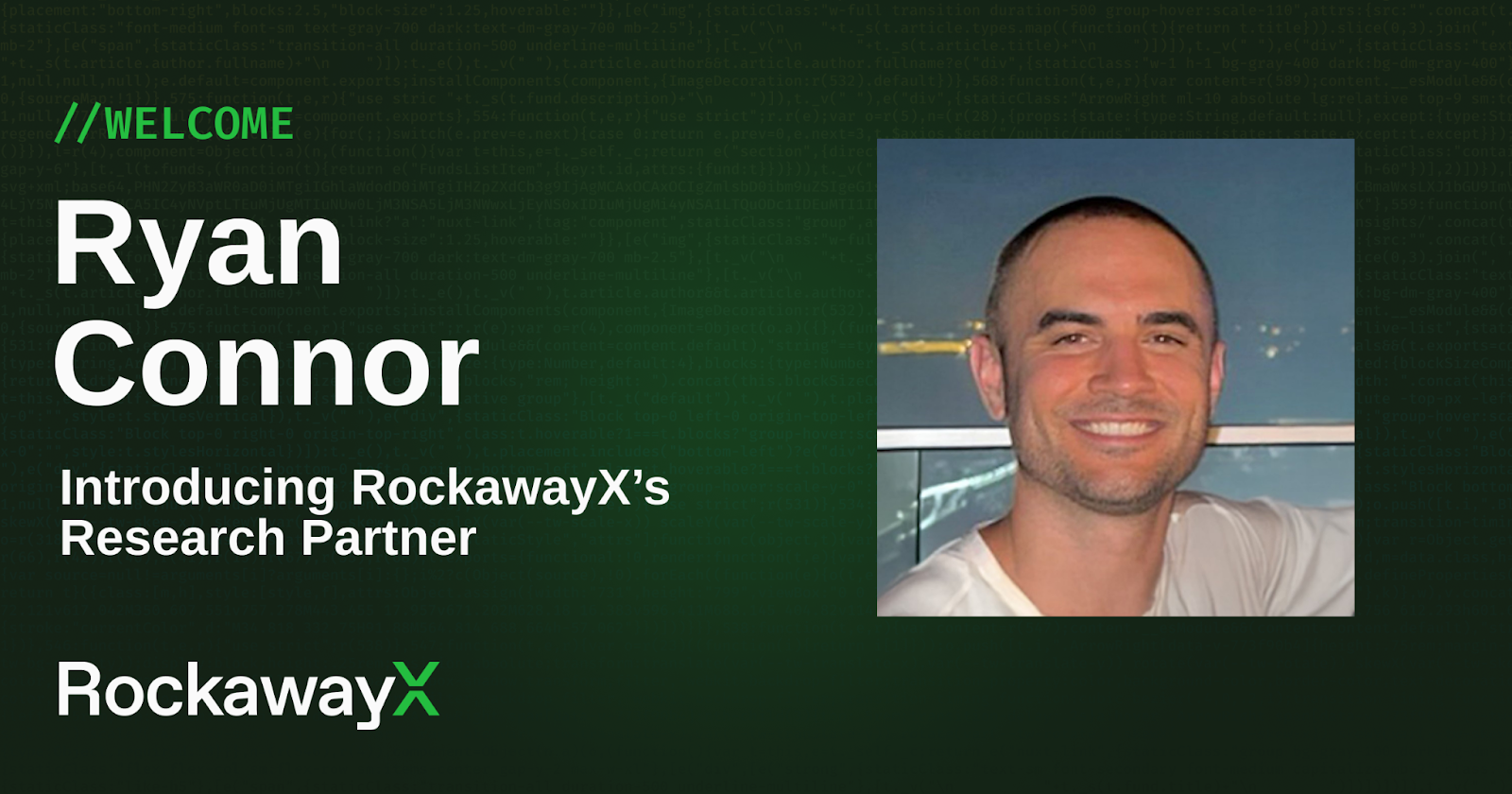
We’re thrilled to introduce Ryan Connor as RockawayX’s new Research Partner!
Ryan joins our investment team, where he will be responsible for periodic market (and macro) updates, creating best-practice investment analysis on tokens and equities with traction and fundamentals, and investing in deals aligned with our firm’s “yield-on-chain” thesis.
Ryan previously built Blockworks Research into one of the most respected research products in crypto, and he arrives at a moment when the gap between noise and signal in this industry is wide. As capital returns to the market, regulatory clarity improves, and traditional finance moves closer to crypto, we believe thoughtful, differentiated alpha-driven research will matter more than ever.
We sat down with Ryan to talk about how he got into crypto, his research approach, what he thinks the market is getting wrong right now, and where he sees the biggest opportunities ahead.
How did you get into the space, and what shaped how you think about research in crypto?
I came into crypto through a macro lens. Back in 2019, I was managing a macro strategy and initially became interested in Bitcoin and ETH as macro assets, assets that, under certain conditions, might outperform and therefore deserved a place, even if only a small one, inside a broader portfolio.
That curiosity kept building until I eventually made the jump to Blockworks Research in 2024. There, we built and scaled a research product around a fairly specific thesis: too much crypto research was focused on technology in the abstract, while not enough of it was genuinely additive to investment portfolios.
My background in traditional finance shaped that view in a big way. In equity markets, fundamentals matter. Strategy matters. There is a long and well-documented history of what tends to work in tech markets and what does not.
At the time, crypto often behaved as if those lessons were either irrelevant or not worth applying. We took the opposite view, that if you brought a more practical, alpha-driven approach into crypto research, and borrowed some of the lessons from TradFi and technology markets, you could build something genuinely differentiated. I think that became the wedge for Blockworks Research, and I’m excited to pursue a similar standard at RockawayX.
Blockworks Research was hugely successful. Why did you decide to make the jump to something new, and why RockawayX?
What became obvious to me very quickly, especially after meeting Viktor and the rest of the team, is just how much talent is concentrated under one roof at RockawayX. There are multiple business lines here, and each of them is operating at a very high level while continuing to expand its market share and brand presence.
That kind of talent density is rare.
What also stood out was RockawayX’s ability to understand both worlds at once: the crypto-native world and the traditional finance world. That dual fluency is going to matter more and more as traditional finance becomes increasingly crypto-curious and starts looking for asset managers and strategies that genuinely understand how both systems work. Crypto is becoming more legible to traditional finance, but it is still crypto, and you need expertise on both sides to navigate that well.
Just as important is the platform approach. RockawayX has venture, liquid strategies, market-neutral, infrastructure, and solver operations, and those business lines have synergies and reinforce one another. Very few asset managers in crypto are set up to benefit from that kind of interconnected platform model, and that was a major part of the appeal for me.
There is a lot of slop research in crypto, especially now in the age of AI. What separates high-quality, impactful research from noise?
I think the answer is the same before and after AI: truly valuable research surfaces insights that are not already obvious to everyone else.
If something is already the top result on Google or it is everywhere on Crypto Twitter, then by definition, it is probably not much of a signal. Good research has to extract signal from an extremely noisy environment, and that usually means finding information, context, or perspective that is not already broadly distributed.
That is where human judgment still matters. An LLM cannot spend years building trust with founders. It cannot develop long-term context on how specific teams think, how different players inside a vertical actually operate, or what strategies are really taking shape beneath the surface. It can summarize what is already out there, but it cannot easily surface the things that are not.
That, to me, is the essence of alpha-generative research. It is not just summarizing information. It is surfacing non-obvious insights and reasoning well from them. If your research is not doing that, it is probably not especially relevant.
And how do you want that kind of research to show up through RockawayX?
We are not trying to publish constantly just for the sake of volume. There is always a temptation to say something about everything, but not everything happening in crypto is interesting, and not every observation adds value to the market or to a portfolio.
The goal is to be selective.
We want to speak when we think we have found something genuinely exceptional, something the market is missing, and something that can add to the conversation, whether the reader is deeply crypto-native or coming from a traditional finance background.
RockawayX has a unique advantage here because so much insight already exists inside the firm.
It comes from our portfolio companies, from market-making operations, from the market-neutral fund, and from the many places where we are actively engaged in the market rather than simply observing it from the outside. The opportunity is to turn that insight into research when it is truly additive.
Is there anything the market is getting wrong right now?
A lot, honestly.
One thing that feels especially obvious to me is that the market is treating this moment as a reason to disengage, when I think it should be treating it as a gift. During the 2024 run, there was a real concern that prices were simply going to run away and that high-quality tokens would never offer attractive entry points again, especially in an environment where regulatory clarity was improving, and the marginal dollar increasingly seemed likely to come from traditional finance.
Instead, we got the opposite.
Now you have situations where tokens are trading below the cash value on their balance sheets. You hear people saying crypto is over, that venture is dead, that tokens are broken, that everything should be equity instead. I would take the other side of all of those arguments.
We have seen this movie before. In 2022 and 2023, conviction got shaken out of the market, and many of the people who lost faith missed extraordinary upside afterward. Something similar is happening again. The volatility is real, and the bear case is not without substance, but I think a lot of people are taking the right observations and drawing the wrong conclusion from them.
From my perspective, this is one of the best allocation environments of my career. That is true in venture, in liquid tokens, and even in traditional markets more broadly. Part of that is regulatory clarity in crypto and better distribution than the industry has ever had, and part of it is that AI is going to create step-function improvements across a wide range of markets. When you get that combination, you want to be allocated.
What are you most excited about over the next 12 months as part of the team?
One of the things I think the market is correctly identifying, even if many people are reacting to it the wrong way, is that a lot of token structures are broken. And when token structures are broken, that has consequences not only for investors but for teams, because teams are often compensated in those same tokens. That affects morale, incentives, and ultimately product execution.
To me, that points to a product cycle ahead. Some teams are going to lose focus. Some will walk away. Some will get distracted by AI or by adjacent narratives. And when that happens, openings emerge for new teams to compete with incumbents.
That is what excites me over the next 12 to 18 months: finding the teams that use this environment to build category-defining products. I think there is a high likelihood that some of the next truly important crypto projects are going to be founded in this current market environment, and I’m excited to help identify those teams, work with them, and support them as they grow.
Is there one category you are especially excited about right now?
There is a lot happening in DeFi that I find exciting, and I think there is still room for category-defining products across multiple verticals. But the area I am personally most drawn to right now is the more experimental side of onchain consumer finance.
What NFTs showed a few cycles ago, and what products like Pump.fun and prediction markets have shown more recently, is that there is still an enormous open design space around financial consumer applications in crypto. We have barely scratched the surface there.
Not many founders have seriously worked on the problem of entertainment finance, yet these products can be sticky, high-margin, and genuinely blue-ocean. At the same time, because so much attention is currently flowing toward RWAs, stablecoins, and other areas that are legible to traditional finance, the consumer category is being left unusually open.
That is exactly why it is interesting. Some of the most important categories in technology once looked silly before they looked inevitable, and I think crypto consumer products can follow a similar path. So if there are founders building something weird, unconventional, or something that looks like a toy, I would not dismiss that. It could be less crazy than it sounds.
Ryan is joining RockawayX at a moment when the market is noisy, conviction is scarce, and opportunity is open for teams willing to think independently and build with patience. Stay tuned for more to come!
Give him a follow on X and connect on LinkedIn.


